How can migratory birds help to (re)think of space as possibilities for the more-than-human?
Lines - Knots - Meshworks - Domesticity
Introduction
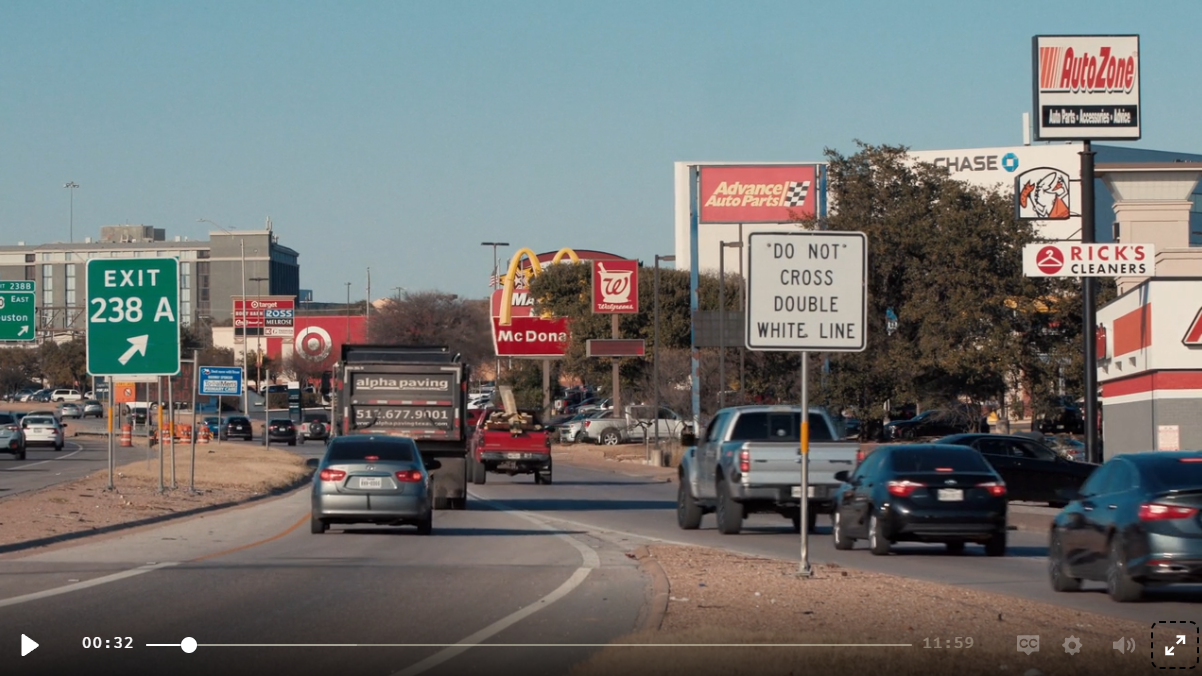
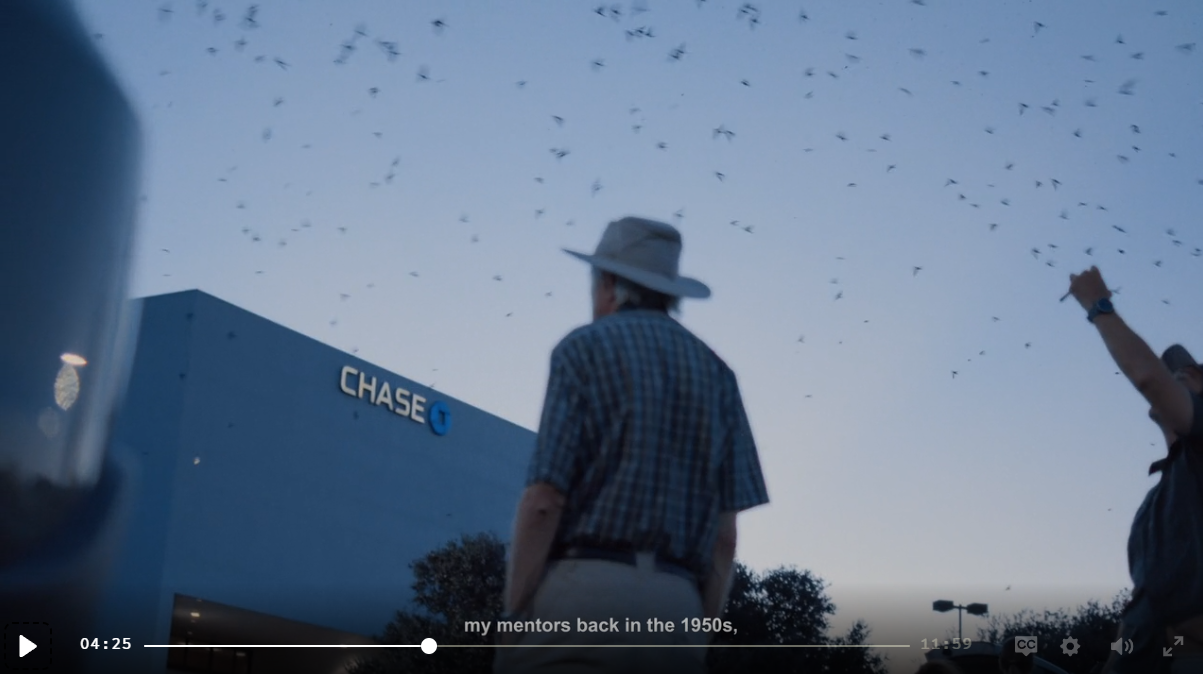
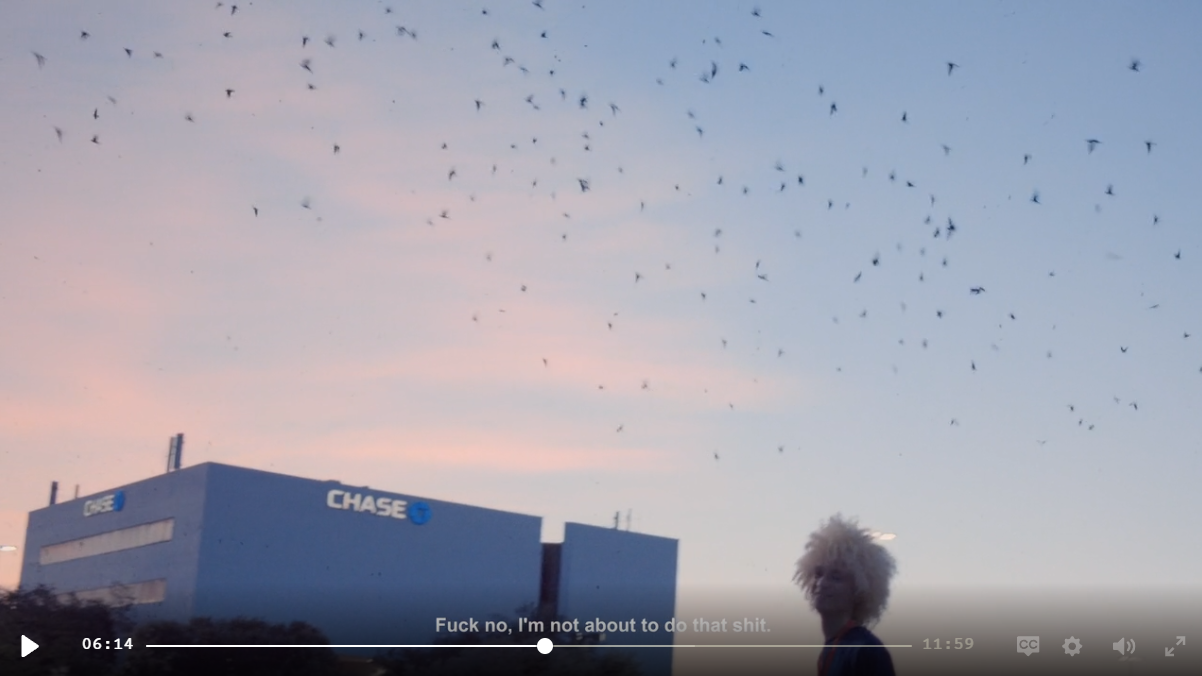
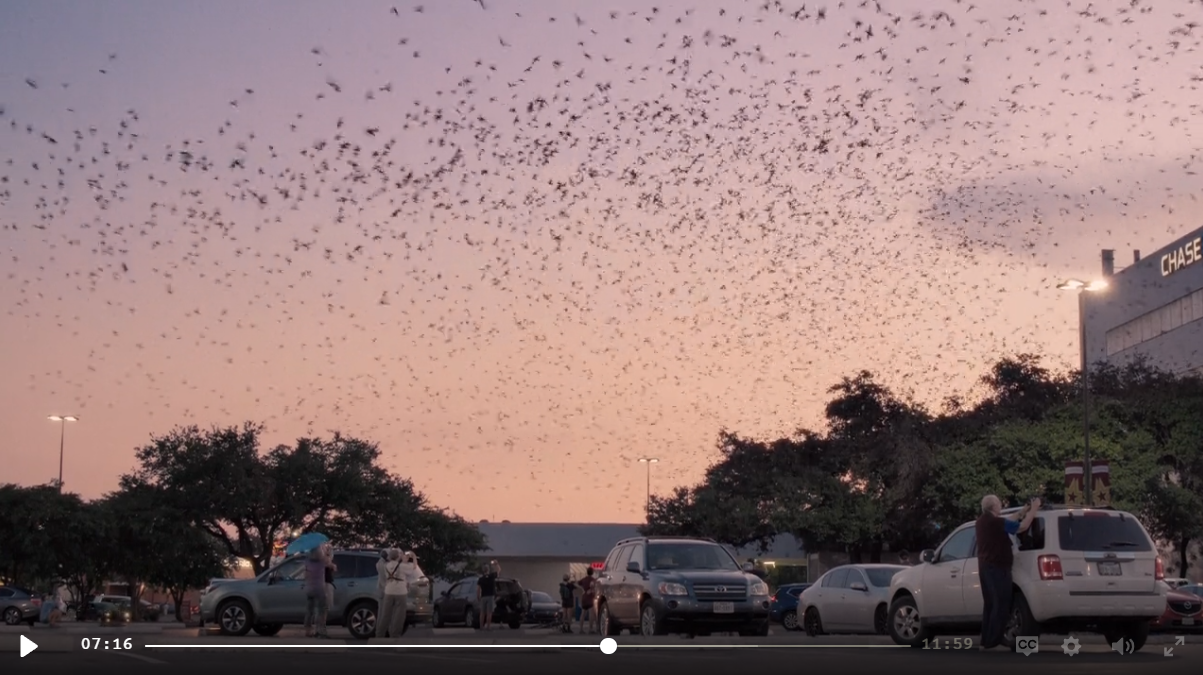
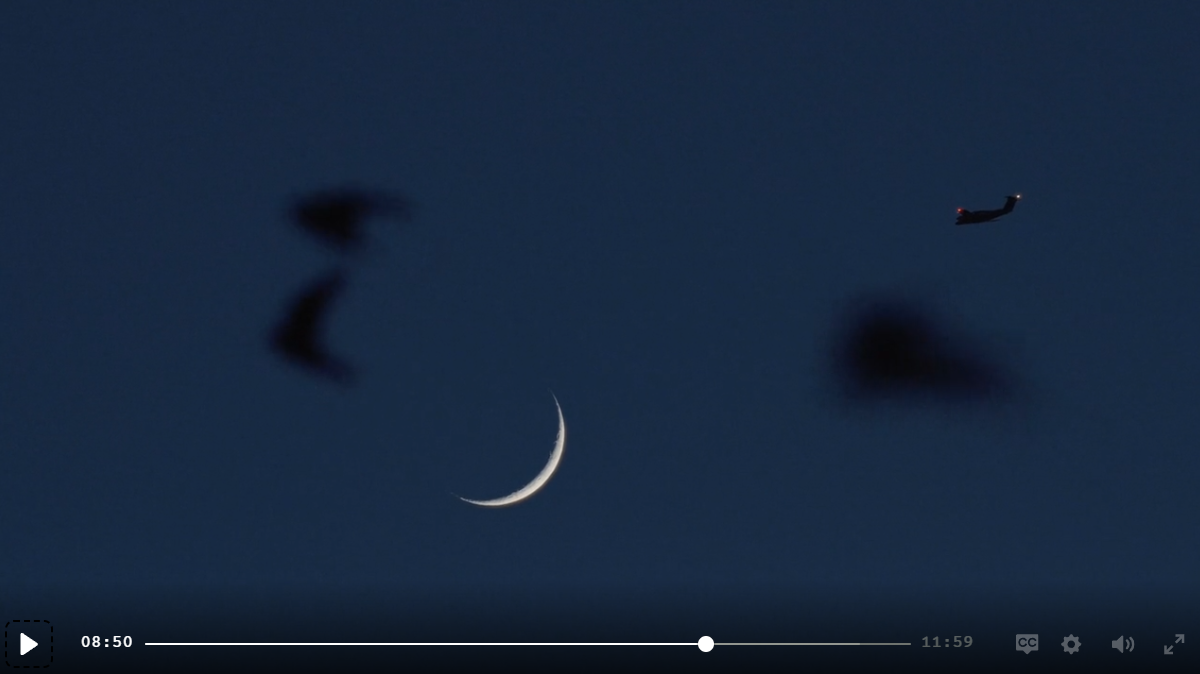
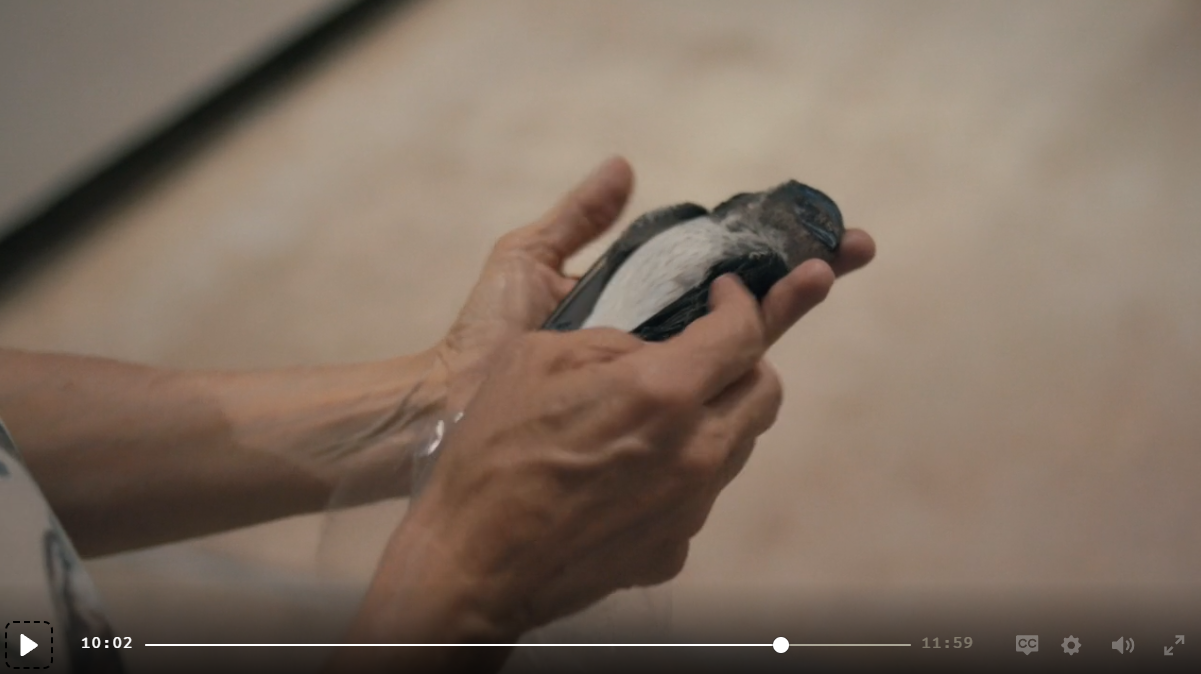
In their 2024 short film, Henry Davis documents one stop of many in the annual five-thousand-mile journey of purple martins from NE United States, to southern Brazil Davis 2024Davis, H. (2024) Exit 238 [film]. Emergence Magazine, 25 January.. In his neighbourhood of Austin, Texas, off of Exit 238A at a strip mall parking lot. The soundscapes along its twelve minute duration are largely free of music, giving way to the affective qualities of highway traffic, chirping martins, human chattering, the drone of a helicopter, the deep rumble of a motorbike engine. These intertwine against visuals of the homogenous American strip mall, a stark cube of glass that is Chase Bank dominating the otherwise empty skyline, and of course the flocks of martins that stop off in the trees of these more-than-human spaces Braun 2005Braun, B. (2005) ‘Environmental issues: writing a more-than-human urban geography’, Progress in Human Geography, 29(5), pp. 635–650. in order to roost. The final few minutes follow an older woman wearing an Audubon spotter guide shirt as she strolls over the base of Chase Bank building to pick up bird that was killed colliding against the window, reflecting that they’d repeatedly called the bank asking to turn off their lights with no success. Quantitative reviews of estimates of bird-building collision mortality place the median at 599 million birds annually in the US Loss et al. 2014Loss, S.R. et al. (2014) ‘Bird–building collisions in the United States: Estimates of annual mortality and species vulnerability’, The Condor: Ornithological Applications, 116(1), pp. 8–23..
Geography by nature focuses on the local; humans are quite local too with the invention of planes and flight still held in relatively recent memory. As grounded actors it could be helpful in thinking through ontologies that subvert traditional cognitive frameworks so that we can begin to unpack how animals and ‘wildlife’ are dynamic agents in producing space as much as the human is Wu 2025Wu, L. (2025) ‘More-than-Human Geography: Core Issues and Trends’, International Journal of Social Sciences and Public Administration, 7(2), pp. 29–43.. How particular species of migratory birds can open doors into thick wordly modes of thinking with vibrant possibilities to extend across space is the question I explore through Purple Martins.
Purple Martins
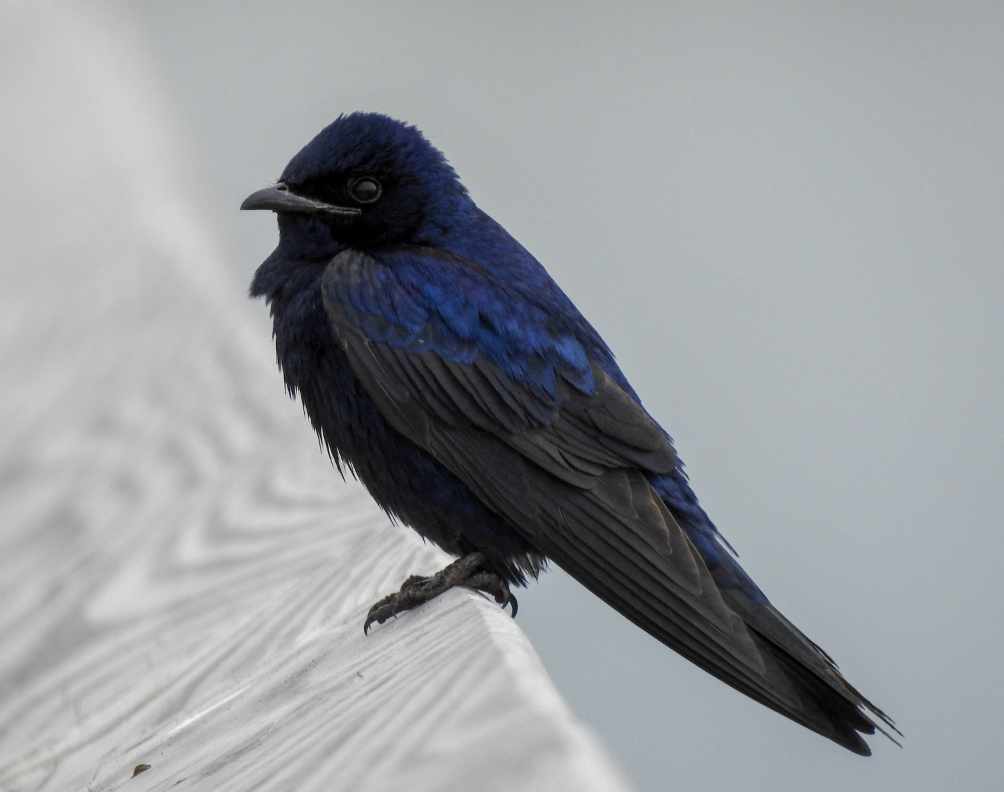
Figure 1. Purple Martin (Progne subis). Photograph: Thomas 2019Thomas, R. (2019) Purple Martin (Progne subis) [photograph]. ML181881821. Ithaca, NY: Macaulay Library, Cornell Lab of Ornithology..
The Cornell Lab species page for Purple Martins opens swiftly on Audubon’s observation of their domestically entangled histories Brown 2021Brown, C.R., Airola, D.A. and Tarof, S. (2021) Purple Martin (Progne subis), version 2.0. In Birds of the World (P.G. Rodewald, Editor). Ithaca, NY: Cornell Lab of Ornithology.:
“Almost every country tavern has a martin box on the upper part of its sign-board; and I have observed that the handsomer the box, the better does the inn generally prove to be.” — John James Audubon, 1831
Noted for their diet of exclusively flying insects, these birds migrate long distances that span the vertical centre of North America, with the latitudes at which they breed being highly correlated with migratory timings Neufeld et al. 2021Neufeld, L.R. et al. (2021) ‘Breeding latitude is associated with the timing of nesting and migration around the annual calendar among Purple Martin (Progne subis) populations’, Journal of Ornithology, 162(4), pp. 1009–1024.. Their storied pasts of human interrelationships are noted to distinguish from ‘nearly all other [birds] in North America’.
Due to anthropogenically induced habitat destruction, Martins are now found to be dependant on a network of human “landlords” for their nesting Jervis et al. 2019Jervis, L.L. et al. (2019) ‘Resisting Extinction: Purple Martins, Death, and the Future’, Conservation and Society, 17(3), p. 227.. This uneven form of coexistence predates the contemporary discourses of ‘Anthropocene’ as polysemic abstraction of emergent ordinaries Fredriksen 2025Fredriksen, A. (2025a) ‘Anthropocene ordinary: Emergent worlds with/in imaginaries of anthropogenic planetary crisis’, Progress in Human Geography, 49(5), pp. 489–507., and enabler of depoliticisation and populist techno-managerial interventions Swyngedouw & Ernstson 2018Swyngedouw, E. and Ernstson, H. (2018) ‘Interrupting the Anthropo-obScene: Immuno-biopolitics and Depoliticizing Ontologies in the Anthropocene’, Theory, Culture & Society, 35(6), pp. 3–30.. Chactaw, Chickasaw, Cherokee communities hung dried calabash gourds on poles to attract Martins Wilson et al. 1812Wilson, A. et al. (1812) American ornithology, or, The natural history of the birds of the United States. Philadelphia: Bradford and Inskeep, pp. 1–150., after which European colonial displacement in the genocide of indigenous nations introduced starlings and house sparrows. This further pushed martins into dependence on human reproduced habitats which continues to shape their being in today’s landscape.
Within ontological frames that construct the identity of Martins around their ‘landlords’, Jervis et al. deem them synanthropes that “prefer” dwelling in close proximity to humans, citing that they “allow” humans to touch them without flying away. The projection of human affects of consent and desire have landlords term them wild or backyard ‘pets’. The focus on interior spatialities of the domestic bring the paper to its conclusion of uncertain futures mediated through shifting demographics of the landlords themselves. Citing the slow unravellings of extinctions ‘dull edge’ Van Dooren 2014Van Dooren, T. (2014) Flight ways: life and loss at the edge of extinction. New York: Columbia University Press., this can facilitate productive discussions for the messy realities that both sustain and let die wild lives, read through a biopolitics of wildlife conservation Srinivasan 2014Srinivasan, K. (2014) ‘Caring for the Collective: Biopower and Agential Subjectification in Wildlife Conservation’, Environment and Planning D: Society and Space, 32(3), pp. 501–517.. For those interested in birdwatching or the provisioning of nests, much of their language frames Purple Martins as enjoying participants of loving symbiotic relationships Porter n.d.Porter, D. (no date) Purple Martins: how it all began. birdwatching.com.Yoest 2025Yoest, H. (2025) ‘For the birds: a Purple Martin sanctuary’, WALTER Magazine, May.. Undeniably the landlords do engage in acts of care and favoured stewardship towards Martins; cleaning out nests and parasites, removing nests of competitor birds or directly trapping them Kelly & Hvenegaard 2022Kelly, B.D. and Hvenegaard, G.T. (2022) ‘Impacts of purple martin landlord stewardship activities on nest box occupancy’, Wildlife Society Bulletin, 46(1), e1247..
The domestic of human made nests
Proceeding from early indigenous forms, Purple Martins have been provided an intriguing array of domestic architectures. Some of the earliest houses, were precisely human homes shrunk down at scales that affect toy models of Edwardian and late Victorian aesthetics.
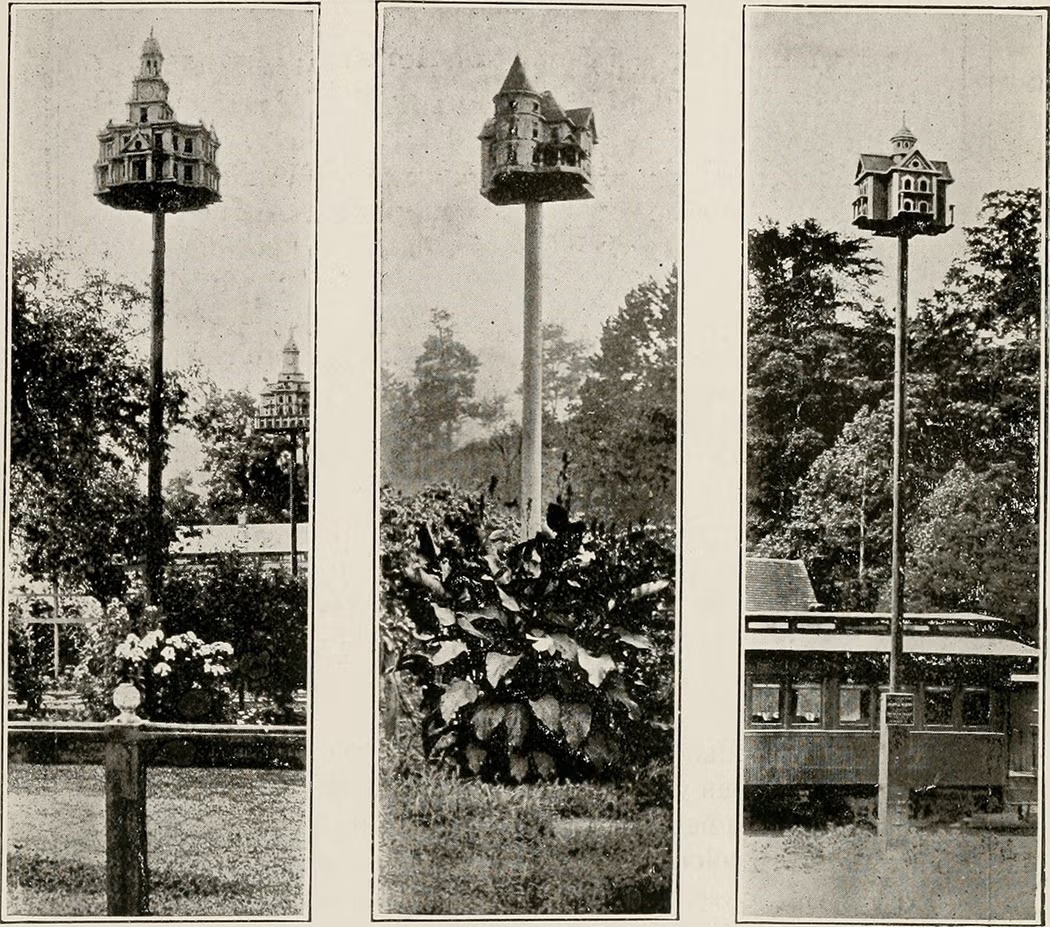
Figure 2. Jacob’s Martin houses — miniature Victorian and Edwardian architectures (Gleanings from Nature, 1898).
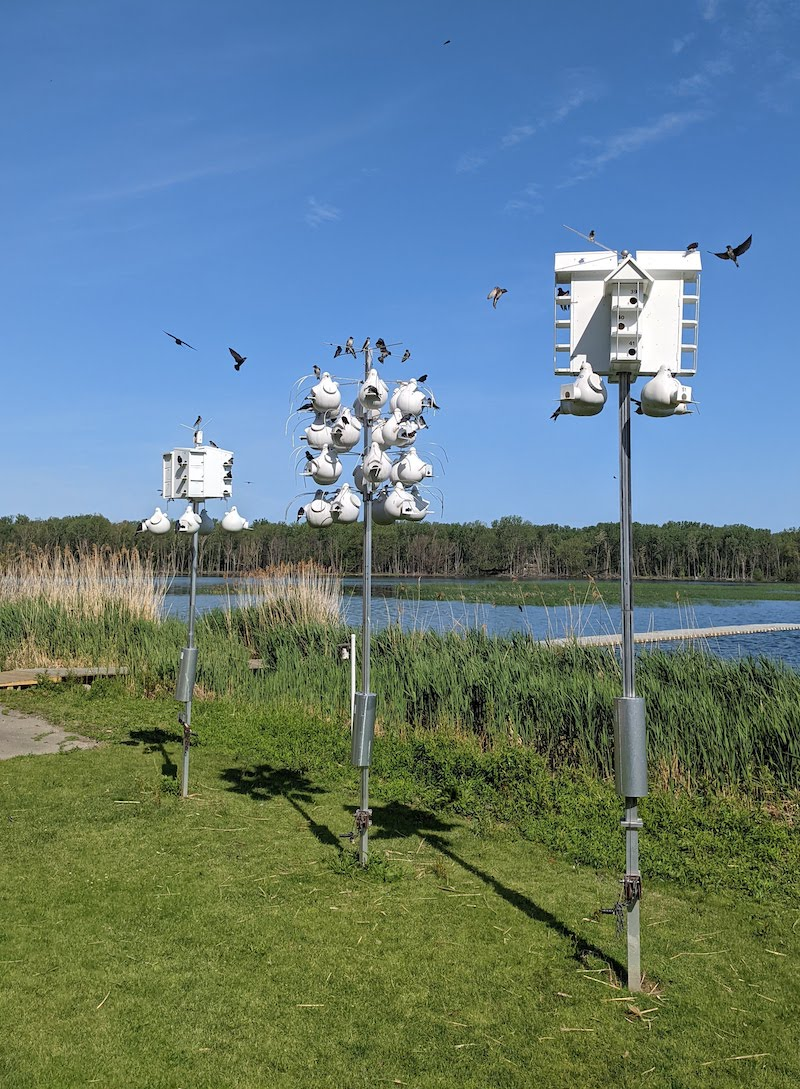
Figure 3. Contemporary martin housing, its plastic gourd clusters echoing the calabash tradition PMCA n.d.Purple Martin Conservation Association (2021) Purple martin houses [photograph]..
Although coming back full circle with distinct emulations of past gourds, contemporary housing design exude strange cyber-imaginaries of communication technology infrastructure in its clean plastic and metal construction.
Recent affective and feminist turns in geography have surfaced homes as productive and nurturing sites of the more-than-human Fair 2024Fair, H. (2024) ‘Labor, violence and the unfamiliar: Animals’ geographies of the more-than-human home’, Progress in Environmental Geography, 3(4), pp. 332–351.. There is both refuge and violence to be accounted for when thinking through homes as extensions to unbounded social relations and public spaces. A focus on animal geographies attends to pets who share the indoors with their human actors that allocate them space, when exceeded they are able to determine their own geographies of beastly places.
Yet for Purple Martins, they are neither domesticated pets nor are their ‘homes’ ones of shared cohabitation. The positively accepted term of ‘landlord’ critically foregrounds the violence of domestic spaces and their power imbalances Madden 2025Madden, D. (2025) ‘Social Reproduction and the Housing Question’, Antipode, 57(2), pp. 578–598.. Furthermore these boxes as nests are their literal spaces of social reproduction; although financial rent is not exchanged, the context of anthropogenic change has all but foreclosed the remainder of what alternatives in nesting of natural cavities Purple Martins have access to, forcing them to rely on the provision of informal labour that is undergoing its own demographic destabilisations Jervis et al. 2019Jervis, L.L. et al. (2019) ‘Resisting Extinction: Purple Martins, Death, and the Future’, Conservation and Society, 17(3), p. 227..
The North American arrival of English house sparrows and European starlings both take place in the late 19th century of New York. Downstream of colonial and frontier ambitions Cronon 1996Cronon, W. (1996) ‘The Trouble with Wilderness: Or, Getting Back to the Wrong Nature’, Environmental History, 1(1), pp. 7–28., the motivations of nostalgia and cultural acclimatisation are directly responsible for the importing of both these species Ritvo 2012Ritvo, H. (2012) ‘Going Forth and Multiplying: Animal Acclimatization and Invasion’., accelerating the martins’ dispossession and shift to human-made housing. Red-billed Leiothrixes have similarly been used as synecdoche of colonial-capitalist histories of trade Fredriksen 2025Fredriksen, A. (2025b) ‘Re-sounding spring: listening to planetary crisis and survival in recombinant birdsong’, cultural geographies.. Rejecting the opaque narratives of ‘invasive’ species that erase settler colonisation and violent geopolitical events, Fredriksen makes a case for ‘listening’ to their evidence through the reconstituted soundscapes of the birds that accompanied these moments.
Exit 238 frames one evening within the martin’s wider migration as a thing of ephemeral beauty, a brief confluence in time. This can be interpreted as representation of a stable network with heterogeneous entities, something useful for analysing more locally contained typologies of space Johnston 2008Johnston, C. (2008) ‘Beyond the clearing: towards a dwelt animal geography’, Progress in Human Geography, 32(5), pp. 633–649.. However this is limited in reflecting the seasonal flux of migratory birds and a multiplicity of non-human and human actors implicated in their flight ways, which can instead be better constituted by the more relational Whitehouse 2015Whitehouse, A. (2015) ‘Listening to Birds in the Anthropocene: The Anxious Semiotics of Sound in a Human-Dominated World’, Environmental Humanities, 6(1), pp. 53–71.Wu 2025Wu, L. (2025) ‘More-than-Human Geography: Core Issues and Trends’, International Journal of Social Sciences and Public Administration, 7(2), pp. 29–43. and processual ontologies of flows and ‘meshworks’ Rodríguez-Giralt et al. 2014Rodríguez-Giralt, I., Tirado, F. and Tironi, M. (2014) ‘Disasters as Meshworks: Migratory Birds and the Enlivening of Doñana’s Toxic Spill’, The Sociological Review, 62(1_suppl), pp. 38–60.Whitehouse 2015Whitehouse, A. (2015) ‘Listening to Birds in the Anthropocene’, Environmental Humanities, 6(1), pp. 53–71.. A tunnel-visioned focus on martin nests and stop-offs extracts their borderless being to cage it within the local concern of human place.
Migration and Meshworks
Centring the role of migratory birds, Rodríguez-Giralt et al. 2014Rodríguez-Giralt, I., Tirado, F. and Tironi, M. (2014) ‘Disasters as Meshworks: Migratory Birds and the Enlivening of Doñana’s Toxic Spill’, The Sociological Review, 62(1_suppl), pp. 38–60. draw on Ingold’s concept of meshworks to understand a toxic spill in Doñana as a ‘vibrant ontology of disaster’. As a premier wildlife reserve and vital resting site in the flight ways of millions of migratory birds, the meshwork remakes birds as active lines of becoming as well as contamination. Their agency is conceptualised through enmeshing further human and non-human actors, in addition to the transporting toxins higher up along food chains. Their embodied freedom across space produces vectors that struggle to be contained in the local between Aznalcóllar mine and the national park.
Combined with theories of relational semiotics, birdsong is developed as a territorialisation of space, with their loss or disruption as an ecological acoustic sign of general absences to relations and companionship Whitehouse 2015Whitehouse, A. (2015) ‘Listening to Birds in the Anthropocene: The Anxious Semiotics of Sound in a Human-Dominated World’, Environmental Humanities, 6(1), pp. 53–71.. This can give rise to human senses of anxiety and loss, that are equally oriented back towards the birds through meshworks to reject exceptionalism, giving way to the idea that any organism is emergent through these entangled and interwoven lines.
In lieu of a physical and embodied travel to go be with them along points of migration, this framework helps me to recontextualise their identity beyond the dominant narratives of purple martins as domestic pets with exceptional moments of spectacle. Several birds through tangent discursive framework are already textured with greater agency and nuance, from crows and penguins Van Dooren 2014Van Dooren, T. (2014) Flight ways: life and loss at the edge of extinction. New York: Columbia University Press.van Dooren 2018van Dooren, T. (2018) ‘Thinking with Crows: (Re)doing Philosophy in the Field’, Parallax, 24(4), pp. 439–448. to the black cockatoos of Australia Houston 2021Houston, D. (2021) ‘Planning in the shadow of extinction: Carnaby’s Black cockatoos and urban development in Perth, Australia’, Contemporary Social Science, 16(1), pp. 43–56.. In field ornithology studies, remote sensing data allows the examination of habitat use by Purple Martins, in typically hidden islands of suitable forest, as disproportionately used for roosting Fournier et al. 2019Fournier, A.M.V. et al. (2019) ‘Precise direct tracking and remote sensing reveal the use of forest islands as roost sites by Purple Martins during migration’, Journal of Field Ornithology, 90(3), pp. 258–265.. Notably they discredit the narratives of observational and anecdotal data in identifying common roosts or stopovers as near to human development, instead arguing their findings point to ‘no such association’ and identify remote locations like the small island in a lake in Minnesota.
The motivation to look for such discrepancies against predominant assumptions would not arise without greater attention to the lines and meshworks of migration. Taken as knots that bind and territorialise the ongoing flows of migration, sites of roosting and stopover surface as confluences of lines where purple martins become briefly entangled with wilder ecosystems as well as human urban environments. The great distances of migration then serve the purpose of connecting these moments through the vectors of the birds.
Returning to Exit 238, I find my experience of rewatching the film transmuted through new ontologies of understanding space and its various participants. The strip-mall location becomes a site of relational processes, while recognising the identity of Purple Martins beyond their birdsong; moments of spectacle; victimhood to physical infrastructures of increasingly urban life worlds. Differing from more affective elements that were noticed in my initial watch of the film, the stopover of the Purple Martins can now be understood as a reterritorialisation of that urban space within their migration patterns, co-constituting the experience and being of other actors, both human and non-human.
Additionally towards more nuanced understandings of their housing as mediated through human produced infrastructures, I find that ‘wildlife’ can sit in tension between modes of domestication and the untethered flight-ways of extended migration. These conceptualisations can lend itself to suggesting for ‘multispecies governance’ in contexts that inform urban planning Wu 2025Wu, L. (2025) ‘More-than-Human Geography: Core Issues and Trends’, International Journal of Social Sciences and Public Administration, 7(2), pp. 29–43., taking into account the routes of migratory birds with the aim of reducing the vast and violent statistics that affect bird populations.
Exit 238 (2024) · Henry Davis · Emergence Magazine · 11 min 58
References
- Braun, B. (2005) ‘Environmental issues: writing a more-than-human urban geography’, Progress in Human Geography, 29(5), pp. 635–650.
- Brown, C.R., Airola, D.A. and Tarof, S. (2021) Purple Martin (Progne subis), version 2.0. In Birds of the World (P.G. Rodewald, Editor). Ithaca, NY: Cornell Lab of Ornithology.
- Cronon, W. (1996) ‘The Trouble with Wilderness: Or, Getting Back to the Wrong Nature’, Environmental History, 1(1), pp. 7–28.
- Davis, H. (2024) Exit 238 [film]. Emergence Magazine, 25 January. emergencemagazine.org
- van Dooren, T. (2018) ‘Thinking with Crows: (Re)doing Philosophy in the Field’, Parallax, 24(4), pp. 439–448.
- Fair, H. (2024) ‘Labor, violence and the unfamiliar: Animals’ geographies of the more-than-human home’, Progress in Environmental Geography, 3(4), pp. 332–351.
- Fournier, A.M.V. et al. (2019) ‘Precise direct tracking and remote sensing reveal the use of forest islands as roost sites by Purple Martins during migration’, Journal of Field Ornithology, 90(3), pp. 258–265.
- Fredriksen, A. (2025a) ‘Anthropocene ordinary: Emergent worlds with/in imaginaries of anthropogenic planetary crisis’, Progress in Human Geography, 49(5), pp. 489–507.
- Fredriksen, A. (2025b) ‘Re-sounding spring: listening to planetary crisis and survival in recombinant birdsong’, cultural geographies.
- Gleanings from Nature (1898) Jacob’s Martin houses [illustration]. Wikimedia Commons.
- Houston, D. (2021) ‘Planning in the shadow of extinction: Carnaby’s Black cockatoos and urban development in Perth, Australia’, Contemporary Social Science, 16(1), pp. 43–56.
- Jervis, L.L. et al. (2019) ‘Resisting Extinction: Purple Martins, Death, and the Future’, Conservation and Society, 17(3), p. 227.
- Johnston, C. (2008) ‘Beyond the clearing: towards a dwelt animal geography’, Progress in Human Geography, 32(5), pp. 633–649.
- Kelly, B.D. and Hvenegaard, G.T. (2022) ‘Impacts of purple martin landlord stewardship activities on nest box occupancy’, Wildlife Society Bulletin, 46(1), e1247.
- Loss, S.R. et al. (2014) ‘Bird–building collisions in the United States: Estimates of annual mortality and species vulnerability’, The Condor: Ornithological Applications, 116(1), pp. 8–23.
- Madden, D. (2025) ‘Social Reproduction and the Housing Question’, Antipode, 57(2), pp. 578–598.
- Neufeld, L.R., Muthukumarana, S., Fischer, J.D., Ray, J.D., Siegrist, J. and Fraser, K.C. (2021) ‘Breeding latitude is associated with the timing of nesting and migration around the annual calendar among Purple Martin (Progne subis) populations’, Journal of Ornithology, 162(4), pp. 1009–1024. doi.org
- Porter, D. (no date) Purple Martins: how it all began. birdwatching.com.
- Purple Martin Conservation Association (2021) Purple martin houses [photograph]. appvoices.org.
- Ritvo, H. (2012) ‘Going Forth and Multiplying: Animal Acclimatization and Invasion’. hdl.handle.net.
- Rodríguez-Giralt, I., Tirado, F. and Tironi, M. (2014) ‘Disasters as Meshworks: Migratory Birds and the Enlivening of Doñana’s Toxic Spill’, The Sociological Review, 62(1_suppl), pp. 38–60.
- Srinivasan, K. (2014) ‘Caring for the Collective: Biopower and Agential Subjectification in Wildlife Conservation’, Environment and Planning D: Society and Space, 32(3), pp. 501–517.
- Swyngedouw, E. and Ernstson, H. (2018) ‘Interrupting the Anthropo-obScene: Immuno-biopolitics and Depoliticizing Ontologies in the Anthropocene’, Theory, Culture & Society, 35(6), pp. 3–30.
- Thomas, R. (2019) Purple Martin (Progne subis) [photograph]. ML181881821. Ithaca, NY: Macaulay Library, Cornell Lab of Ornithology.
- Van Dooren, T. (2014) Flight ways: life and loss at the edge of extinction. New York: Columbia University Press.
- Whitehouse, A. (2015) ‘Listening to Birds in the Anthropocene: The Anxious Semiotics of Sound in a Human-Dominated World’, Environmental Humanities, 6(1), pp. 53–71.
- Wilson, A. et al. (1812) American ornithology, or, The natural history of the birds of the United States. Philadelphia: Bradford and Inskeep, pp. 1–150.
- Wu, L. (2025) ‘More-than-Human Geography: Core Issues and Trends’, International Journal of Social Sciences and Public Administration, 7(2), pp. 29–43.
- Yoest, H. (2025) ‘For the birds: a Purple Martin sanctuary’, WALTER Magazine, May.
_(14728890696).jpg)
☾ Hover any citationHover a citation to reveal its full reference. to reveal its full reference. Rendered verbatim from the submitted essay (word count 1855); figures reproduced from their cited sources; opening stills from Exit 238 (Davis 2024). The martins in the field are its meshwork — they pass behind the figures, thin to a murmur over the reading, and settle at the end on the houses that frame the clearing. How can migratory birds help to (re)think of space as possibilities for the more-than-human?, by blu.